Dear All,
Thanks to @nirbheek ,
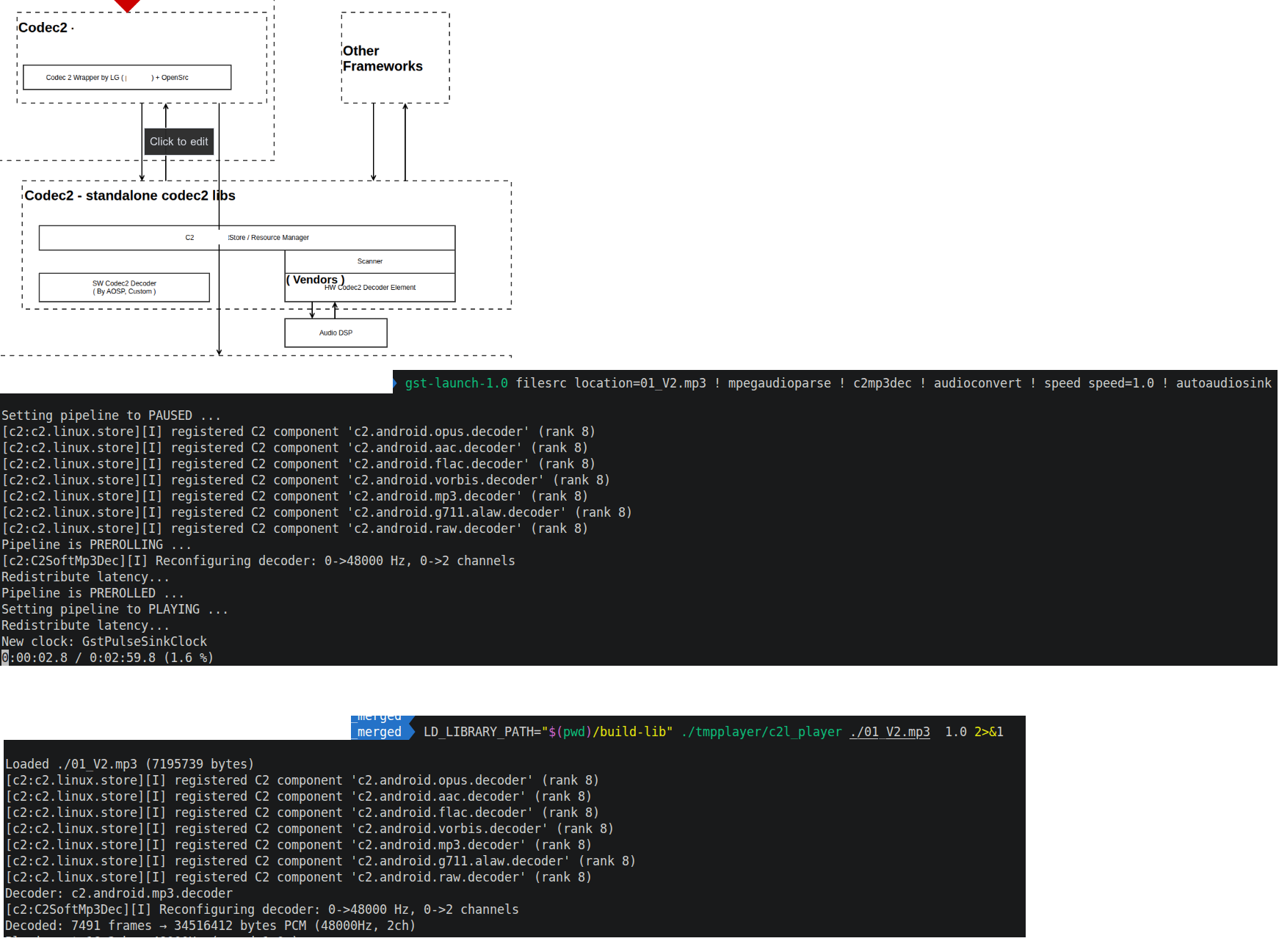
Now I’m updating architecture and testing decoding with both gstreamer and non - gstreamer applications :
I am looking forward to the day I can share this with you all.
/*
 * c2l_player
 * Copyright (c) 2026 Changyong Ahn <changyong.ahn@lge.com>
 */

#include <codec2-linux/codec2_linux.h>
#include <alsa/asoundlib.h>
#include <stdio.h>
#include <stdlib.h>
#include <string.h>
#include <stdint.h>


static int find_mp3_frame(const uint8_t *buf, size_t len, size_t *frame_size) {
    /* MP3 sync: 0xFF 0xE0+ (11 sync bits) */
    for (size_t i = 0; i + 3 < len; i++) {
        if (buf[i] == 0xFF && (buf[i+1] & 0xE0) == 0xE0) {

            int version = (buf[i+1] >> 3) & 3;    /* 0=2.5, 2=2, 3=1 */
            int layer = (buf[i+1] >> 1) & 3;      /* 1=III, 2=II, 3=I */
            int br_idx = (buf[i+2] >> 4) & 0xF;
            int sr_idx = (buf[i+2] >> 2) & 3;
            int padding = (buf[i+2] >> 1) & 1;

            if (version == 1 || layer == 0 || br_idx == 0 || br_idx == 15 || sr_idx == 3)
                continue;

            static const int bitrates[16] = {0,32,40,48,56,64,80,96,112,128,160,192,224,256,320,0};
            static const int samplerates[4] = {44100, 48000, 32000, 0};

            int bitrate = bitrates[br_idx] * 1000;
            int samplerate = samplerates[sr_idx];
            if (version == 0) samplerate /= 4;      /* MPEG 2.5 */
            else if (version == 2) samplerate /= 2;  /* MPEG 2 */

            int fsize;
            if (layer == 3) /* Layer I */
                fsize = (12 * bitrate / samplerate + padding) * 4;
            else /* Layer II, III */
                fsize = 144 * bitrate / samplerate + padding;

            if (fsize > 0 && i + fsize <= len) {
                *frame_size = fsize;
                return (int)i;
            }
        }
    }
    return -1;
}

int main(int argc, char *argv[]) {
    if (argc < 2) {
        fprintf(stderr, "Usage: %s <file.mp3> [speed]\n", argv[0]);
        fprintf(stderr, "  speed: 1.0=normal, 2.0=double, 0.5=half\n");
        return 1;
    }

    float speed = (argc > 2) ? atof(argv[2]) : 1.0f;
    if (speed <= 0) speed = 1.0f;

    FILE *f = fopen(argv[1], "rb");
    if (!f) { perror("fopen"); return 1; }
    fseek(f, 0, SEEK_END);
    size_t file_size = ftell(f);
    fseek(f, 0, SEEK_SET);
    uint8_t *file_data = malloc(file_size);
    fread(file_data, 1, file_size, f);
    fclose(f);
    printf("Loaded %s (%zu bytes)\n", argv[1], file_size);

    C2LContext *ctx = c2l_context_create();
    c2l_context_set_resource_capacity(ctx, "cpu.audio", 100);

    C2LSessionRequest req = {
        .component_name = "c2.android.mp3.decoder",
        .resource_id = "cpu.audio",
        .resource_units = 1,
        .priority = C2L_PRIORITY_FOREGROUND,
    };
    C2LSession *session = NULL;
    C2LStatus st = c2l_session_create(ctx, &req, &session);
    if (st != C2L_STATUS_OK) {
        fprintf(stderr, "session_create failed: %s\n", c2l_status_string(st));
        return 1;
    }
    printf("Decoder: %s\n", c2l_session_component_name(session));

    c2l_session_start(session);

    C2LAudioConfig config = { .sample_rate = 44100, .channels = 2 };
    c2l_session_configure_audio(session, &config);

    size_t pos = 0;
    uint8_t *pcm_buf = NULL;
    size_t pcm_total = 0;
    size_t pcm_cap = 0;
    int detected_rate = 0, detected_ch = 0;
    int frame_count = 0;

    while (pos < file_size) {
        size_t frame_size = 0;
        int offset = find_mp3_frame(file_data + pos, file_size - pos, &frame_size);
        if (offset < 0) break;
        pos += offset;

        C2LInputBuffer input = {
            .data = file_data + pos,
            .size = frame_size,
            .pts_ns = C2L_TIME_NONE,
            .flags = 0,
        };
        c2l_session_queue(session, &input);
        pos += frame_size;
        frame_count++;

        C2LOutputBuffer output = {0};
        while (c2l_session_pull(session, &output) == C2L_STATUS_OK && output.size > 0) {
            if (pcm_total + output.size > pcm_cap) {
                pcm_cap = (pcm_total + output.size) * 2;
                pcm_buf = realloc(pcm_buf, pcm_cap);
            }
            memcpy(pcm_buf + pcm_total, output.data, output.size);
            pcm_total += output.size;
            if (!detected_rate && output.sample_rate) {
                detected_rate = output.sample_rate;
                detected_ch = output.channels;
            }
            c2l_output_buffer_release(&output);
            memset(&output, 0, sizeof(output));
        }
    }

    c2l_session_drain(session);
    C2LOutputBuffer output = {0};
    while (c2l_session_pull(session, &output) == C2L_STATUS_OK && output.size > 0) {
        if (pcm_total + output.size > pcm_cap) {
            pcm_cap = (pcm_total + output.size) * 2;
            pcm_buf = realloc(pcm_buf, pcm_cap);
        }
        memcpy(pcm_buf + pcm_total, output.data, output.size);
        pcm_total += output.size;
        if (!detected_rate && output.sample_rate) {
            detected_rate = output.sample_rate;
            detected_ch = output.channels;
        }
        c2l_output_buffer_release(&output);
        memset(&output, 0, sizeof(output));
    }

    printf("Decoded: %d frames → %zu bytes PCM (%dHz, %dch)\n",
           frame_count, pcm_total, detected_rate, detected_ch);

    c2l_session_stop(session);
    c2l_session_destroy(session);
    c2l_context_destroy(ctx);

    if (!detected_rate) detected_rate = 44100;
    if (!detected_ch) detected_ch = 2;

    int playback_rate = (int)(detected_rate * speed);
    printf("Playing at %dx%dch @ %dHz (speed=%.1fx)\n",
           16, detected_ch, playback_rate, speed);

    snd_pcm_t *pcm_handle;
    int err = snd_pcm_open(&pcm_handle, "default", SND_PCM_STREAM_PLAYBACK, 0);
    if (err < 0) {
        fprintf(stderr, "ALSA open: %s\n", snd_strerror(err));
        fprintf(stderr, "Writing to /tmp/c2l_out.raw instead\n");
        FILE *out = fopen("/tmp/c2l_out.raw", "wb");
        fwrite(pcm_buf, 1, pcm_total, out);
        fclose(out);
        printf("Saved %zu bytes to /tmp/c2l_out.raw\n", pcm_total);
        goto cleanup;
    }

    snd_pcm_set_params(pcm_handle,
        SND_PCM_FORMAT_S16_LE,
        SND_PCM_ACCESS_RW_INTERLEAVED,
        detected_ch,
        playback_rate,
        1,          /* allow ALSA software resampling */
        500000);    /* desired latency in microseconds (500ms) */

    size_t frame_bytes = detected_ch * 2; /* bytes per frame (S16LE = 2 bytes/sample) */
    size_t total_frames = pcm_total / frame_bytes;
    snd_pcm_sframes_t written = snd_pcm_writei(pcm_handle, pcm_buf, total_frames);
    if (written < 0) {
        snd_pcm_recover(pcm_handle, written, 0);
        written = snd_pcm_writei(pcm_handle, pcm_buf, total_frames);
    }
    printf("Played %ld/%zu frames\n", (long)written, total_frames);

    snd_pcm_drain(pcm_handle);
    snd_pcm_close(pcm_handle);

cleanup:
    free(pcm_buf);
    free(file_data);
    printf("Done.\n");
    return 0;
}